If you’re looking into orthodontic treatment in Vancouver and wondering whether LightForce braces or Invisalign makes more sense for your situation, you’re not alone. It’s one of the most common questions patients ask at their first consultation.
Both are modern, technology-driven options. Both use digital scans rather than messy impressions. And both produce results that look nothing like the old metal braces most adults remember from their teenage years. But they work quite differently, and the right choice depends on your teeth, your lifestyle, and honestly, how realistic you’re willing to be about your daily habits.
Here’s an honest breakdown of how they compare.
What Is LightForce?
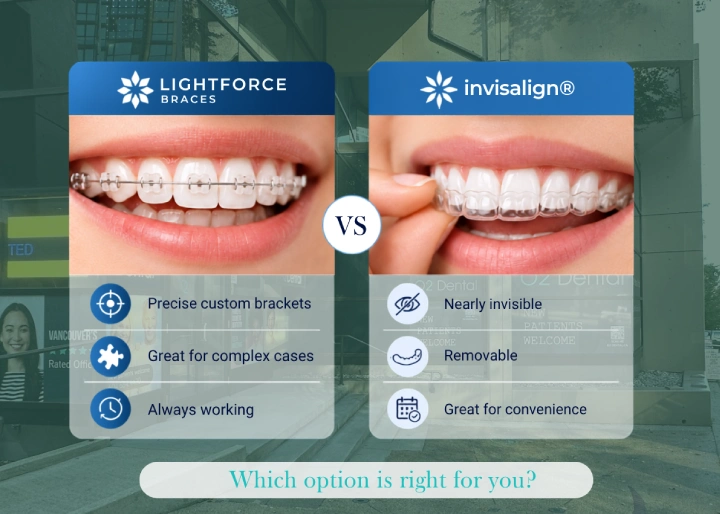
LightForce is a fixed brace system, meaning the brackets bond directly to your teeth and stay there throughout treatment. What makes it different from traditional braces is how those brackets are made. Each one is individually 3D-printed from a clear ceramic material called polycrystalline alumina, designed to fit the exact shape and contour of each tooth rather than using a standard bracket that approximates the fit.
The process starts with a digital scan of your teeth. That scan feeds into software that maps out your full treatment plan, tooth by tooth, and then each bracket is printed specifically for you. Because the fit is precise from the start, LightForce tends to need fewer mid-treatment adjustments than traditional braces. Appointment intervals are typically every 12 to 16 weeks rather than every four weeks.
The brackets are clear, so they’re considerably less noticeable than metal braces, though they’re still visible up close. You can keep them discreet with clear elastics, or go the other direction with coloured bands if you prefer.
What Is Invisalign?
Invisalign uses a series of clear, removable plastic aligners made from a flexible material called SmartTrack. Each aligner moves your teeth a small amount, and you progress through the series over the course of your treatment. The aligners are changed on a schedule set by your orthodontist, typically every one to two weeks.
The defining feature is that they come out. You remove them to eat, drink anything except water, brush, and floss. That also means there are no dietary restrictions, which is one of the main reasons patients prefer Invisalign. When the aligners are in, they’re nearly invisible from a normal conversational distance.
The trade-off is that Invisalign only works as planned if you actually wear the aligners. The standard recommendation is 20 to 22 hours per day. Patients who consistently hit that number get the results their treatment plan predicts. Those who don’t tend to see their treatment run longer than expected.
How They Compare Side by Side
Appearance
Invisalign has the edge here for most people. The clear aligners are close to invisible in everyday settings, which is a big reason adults in particular prefer them. LightForce brackets are much less noticeable than metal braces, but they’re still fixed to your teeth and visible if someone is looking closely.
Comfort
Both involve an adjustment period. Invisalign can cause mild pressure each time you switch to a new aligner, usually for a day or two. LightForce brackets may cause some soreness after an adjustment visit, similar to the experience with any fixed brace. Because LightForce brackets fit the tooth surface precisely, many patients find them less irritating to the inside of the lips and cheeks than standard metal brackets, though this varies from person to person.
Treatment Time
This depends heavily on the complexity of your case, so take general timelines as a rough guide rather than a guarantee. A multi-practice clinical study published in the Journal of Clinical Orthodontics found that LightForce patients averaged 15 to 17 months of treatment compared to around 24 months for patients treated with conventional brackets. The same study found LightForce patients needed 8 to 11 visits compared to 12 to 15 for conventional braces.
Invisalign treatment typically ranges from 6 to 24 months depending on case complexity. Simpler cases can finish quite quickly, while more involved work can take just as long as braces. And as mentioned above, treatment time with Invisalign is directly tied to compliance. If you wear your aligners consistently, your timeline stays on track. If not, it doesn’t.
Suitability for Complex Cases
LightForce is better suited to cases involving significant crowding, complex bite corrections, or other issues that require precise, consistent force applied continuously. Because the brackets are fixed, they work around the clock without relying on patient compliance. Invisalign has improved considerably for complex cases over the years, but fixed braces still handle the most demanding orthodontic work more reliably.
For mild to moderate crowding or spacing issues, both options are generally effective, and the decision often comes down to lifestyle preferences rather than clinical factors.
Eating and Oral Hygiene
With Invisalign, you remove the aligners before eating, so there are no food restrictions. Brushing and flossing are also straightforward since your teeth are fully accessible. Keeping the aligners themselves clean does require some attention though, since they can discolour if not rinsed consistently.
With LightForce, you need to avoid hard, sticky, or crunchy foods that could damage the brackets. Brushing around fixed brackets takes a little more care than brushing unobstructed teeth, and many patients find it helpful to use an interproximal brush or water flosser.
Compliance
This is the most honest difference between the two options. LightForce does its job regardless of your daily behaviour, because it stays on your teeth. Invisalign requires genuine discipline. That’s not a criticism of the system, it’s just the reality. If you know you’ll remove your aligners for meals and put them straight back in, Invisalign can be a great fit. If you’re not confident you’ll consistently wear them 20-plus hours a day, fixed braces may produce more predictable results for you.
Who Tends to Do Well with Each Option
Patients who often do well with LightForce include those with more complex cases, teenagers or anyone who might struggle with aligner compliance, and adults who want a discreet fixed option without committing to the discipline Invisalign requires.
Patients who tend to do well with Invisalign include adults with mild to moderate alignment concerns, people with strong daily routines who know they’ll wear the aligners consistently, and anyone for whom the ability to remove their orthodontic appliance for work events, photos, or social situations is a priority.
Neither is universally better. The right choice depends on your specific teeth and bite, your lifestyle, and a conversation with your orthodontist.
Orthodontic Treatment at O2 Dental in Downtown Vancouver
At O2 Dental, both LightForce and Invisalign are offered by Dr. Mona Afrand, a Certified Specialist in Orthodontics. Having a certified specialist rather than a general dentist perform orthodontic treatment matters when your case has any complexity to it, since specialist training goes well beyond what a general dentistry program covers.
We’re located at 1358 West Georgia Street in Downtown Vancouver, close to Coal Harbour, the West End, and Yaletown, with evening and Saturday appointments available so treatment doesn’t have to mean time off work.
If you’re trying to decide between LightForce and Invisalign, the most useful thing you can do is come in for a consultation. Once we’ve had a look at your teeth and your bite, we can give you a clear recommendation based on what’s actually happening in your mouth rather than general comparisons like this one.
Book your orthodontic consultation online or call us at (604) 684-4420.
Frequently Asked Questions
Can adults get LightForce braces in Vancouver?
Yes. LightForce is suitable for adults and is a popular choice for patients who want fixed orthodontic treatment that’s significantly less noticeable than traditional metal braces. The clear ceramic brackets blend well with natural tooth colour.
Is LightForce faster than Invisalign?
Treatment time depends on the complexity of your case, so it’s not accurate to say one is always faster than the other. A published clinical study found that LightForce averaged 15 to 17 months compared to around 24 months for conventional braces. Invisalign can range from 6 to 24 months. Your orthodontist can give you a realistic estimate based on your specific situation.
Can I switch from Invisalign to LightForce partway through treatment?
In some cases, yes. This depends on how far along treatment is and what your orthodontist recommends. It’s worth raising if your Invisalign treatment isn’t progressing as expected.
Which option is better for teenagers?
For teenagers, LightForce is often a more reliable choice since it doesn’t depend on the patient remembering to wear it consistently. Invisalign does offer a teen-specific version with compliance indicators, but many orthodontists still recommend fixed braces for younger patients who may not maintain the discipline required.
Do both options use digital scans?
Yes. Both LightForce and Invisalign start with a 3D digital scan of your teeth instead of traditional impressions. The scan takes a few minutes and is used to plan your full treatment digitally before anything is made.
Does O2 Dental offer free orthodontic consultations?
The best way to find out what’s included in your first visit is to call us at (604) 684-4420 or book online. Our team can answer questions about what to expect before you come in.