Porcelain veneers can change the shape, colour, and proportion of your teeth in ways that most other treatments cannot match. They are also a significant investment. Once placed, the process cannot be undone. That makes the decision worth researching properly before booking anything.
This post covers what veneers are, what the process looks like from start to finish, who tends to be a good candidate, and a few honest reasons why a dentist might suggest something else first.
What Are Porcelain Veneers?
A porcelain veneer is a thin, custom-made ceramic shell bonded to the front of a tooth. Each shell is roughly 0.3 to 0.5 millimetres thick, about the same as a contact lens. Your dentist shapes and colours it to match your surrounding teeth.
Dentists use veneers to correct deep staining that whitening cannot reach, chipped or worn edges, minor gaps, and teeth that are uneven in shape or size. They are not a fix for decay or serious bite problems. For those concerns, other treatments come first.
There are two main types: porcelain and composite resin. Porcelain is more durable and looks more natural. Composite is a faster procedure but needs replacing sooner. The difference matters more than most patients expect.
Porcelain vs. Composite: Which One Lasts Longer?
Porcelain veneers are made in a dental lab and require two visits. Composite veneers are applied chair-side in one visit. The composite material is more porous than porcelain, which means it picks up staining from food and drink over time.
A peer-reviewed clinical review on porcelain veneer longevity found that roughly 95% of porcelain veneers are still functional at 10 years. Some long-term studies report survival rates as high as 96% at 21 years when veneers are properly bonded to enamel. Composite veneers typically last 5 to 7 years before showing visible wear or staining.
Porcelain takes longer to place, but it holds up significantly longer and looks more natural over time.
What Affects the Investment in Porcelain Veneers?
Porcelain veneers are a meaningful investment, and the total varies from patient to patient. A few factors shape what your treatment involves:
- The number of teeth being treated
- Whether any preparation work is needed first, such as treating gum disease or a cavity before veneers can go on
- The type of veneer material chosen, porcelain or composite
- The dental lab used to fabricate the porcelain
- The complexity of the smile design
Veneers are a cosmetic procedure, so dental insurance rarely covers them. They are also not included under the Canadian Dental Care Plan (CDCP). The best way to get an accurate picture of what your specific treatment would involve is to book a consultation, where Dr. Tehrani can assess your teeth and give you a clear, personalised plan.
Who Is a Good Candidate?
Veneers need a solid foundation. Good candidates generally have:
- Healthy teeth and gums with no active decay or gum disease
- Enough enamel on the teeth being treated (veneers bond to enamel, not to the layer beneath it)
- A stable bite with no major alignment issues
- Cosmetic concerns that veneers can actually fix, such as staining, chips, gaps, or uneven shape
- Realistic expectations about what the treatment can and cannot do
Veneers work especially well for patients with deep, intrinsic tooth staining. This is staining that formed inside the tooth rather than on the surface. Professional whitening cannot reach it. Veneers cover it completely.
Who May Not Be Ready for Veneers Yet
This section is worth reading carefully. Skipping these checks is where outcomes go wrong.
Active gum disease or decay. Your dentist must treat these conditions fully before any cosmetic work begins. Placing veneers over an unhealthy tooth traps the problem and makes it worse.
Teeth grinding (bruxism). Grinding puts significant force on teeth and can chip or loosen porcelain over time. A nightguard is usually required. Severe, uncontrolled grinding may mean a different treatment fits better.
Significant enamel loss. Veneers bond to enamel. If erosion from acid, certain foods, or other causes has worn it away, the bond may not hold reliably. Your dentist will check this during the exam.
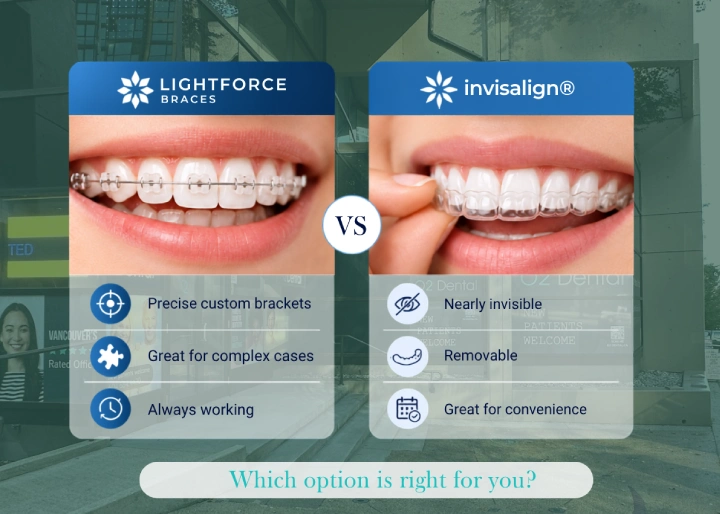
Significant crowding or misalignment. If the position of your teeth is the main concern, Invisalign or LightForce braces correct the root cause rather than covering it. Some patients complete orthodontic treatment first and add veneers afterward for any remaining cosmetic concerns.
Young patients still growing. As the face matures, the fit and appearance of veneers can shift. Most dentists recommend waiting until the patient has reached full growth before proceeding.
None of these situations permanently rules out veneers. They usually mean a preparation phase comes first. A consultation will make that clear.
The Two-Visit Process at O2 Dental
At O2 Dental, Dr. Siamak Khosro Tehrani places porcelain veneers at our clinic at 1358 West Georgia Street in Downtown Vancouver.
Visit one: Preparation and impressions. During the first visit, Dr. Tehrani assesses your teeth, reviews your goals, and confirms whether veneers are the right fit. Digital imaging may preview your expected result before any permanent work begins. Your dentist then removes a small amount of enamel from each tooth being treated, takes digital scans or impressions, and fits temporary veneers while your custom porcelain is made in the lab.
Visit two: Bonding. Your finished veneers are checked for fit, colour, and shape before being permanently bonded to your teeth. Minor adjustments are made at this stage to ensure the bite feels comfortable and the result looks natural.
We serve patients from Coal Harbour, the West End, and Yaletown. Evening and Saturday appointments are available for patients who cannot take time off during the week.
To find out whether veneers are right for your situation, book a consultation online or call us at (604) 684-4420.
Frequently Asked Questions
How long do porcelain veneers last in Vancouver?
Most porcelain veneers last 10 to 15 years with proper care. Well-maintained cases can reach 20 years or more. Clinical research shows roughly 95% of porcelain veneers remain functional at the 10-year mark. Factors that affect lifespan include daily hygiene habits, whether you grind your teeth, and the health of the underlying tooth.
Are porcelain veneers permanent?
The veneers themselves will eventually need replacing. However, the preparation process cannot be undone because a small layer of enamel is removed to fit them. Once you have veneers, your teeth will always need some kind of restoration. This is worth discussing with your dentist before you decide to go ahead.
Do veneers look natural?
When designed carefully, porcelain closely replicates the translucency and texture of natural enamel. The result looks natural from a normal conversational distance and in photos. The quality of the outcome depends on the skill of the dentist and the dental lab making the porcelain.
Can veneers fix crooked teeth?
Veneers can improve the look of mildly uneven teeth, but they do not fix the underlying position. For patients whose main concern is crowding or alignment, Invisalign is usually the better starting point. Your dentist can advise which approach makes sense for your specific situation.
What is the difference between veneers and teeth whitening?
Professional teeth whitening removes surface staining from natural enamel. It works well for staining caused by food, drink, or lifestyle habits, but it cannot change the shape or size of teeth, and it cannot treat staining that formed inside the tooth structure.
Veneers cover the entire front surface of the tooth, which makes them effective for both types of staining as well as chips, gaps, and uneven shape. For patients whose only concern is colour, whitening is usually the better starting point since veneer placement cannot be undone.
How do I know if I am a candidate for porcelain veneers in Vancouver?
The only reliable way to find out is a proper dental exam. Your dentist will check the health of your gums and teeth, the amount of enamel available for bonding, your bite, and your goals. A consultation at O2 Dental will give you a clear picture of your options and whether veneers are the right fit or whether a different treatment would work better for you.